
How Poor Excavation Planning Leads to Costly Repairs and Project Shutdowns
Introduction: Why Excavation Planning Determines Project Success

In modern construction, project failure does not always begin with a visible on-site error. In many cases, it starts much earlier—during Excavation Planning. Before machinery moves, before crews enter the excavation area, and before schedules become difficult to recover, the quality of planning already shapes the project’s direction. A weak plan can turn a routine excavation task into a chain of delays, safety concerns, and financial pressure that affects the entire construction project.
This is especially true in Saudi Arabia, where infrastructure expansion, urban density, and the scale of ongoing development demand a far more disciplined approach to excavation work. In these conditions, poor coordination during the planning stage can expose underground utilities, increase hidden costs, and create risks associated with inaccurate soil assessment or unsuitable excavation methods. As Saudi Arabia continues to accelerate national development under Vision 2030, the margin for avoidable excavation errors becomes smaller, not larger.
For that reason, Excavation Planning should not be treated as a routine preconstruction formality. It is a strategic control point that influences safety, productivity, budget stability, and execution quality. When planning is incomplete, every excavation project becomes more vulnerable to project delays, costly repairs, and damage to critical utility corridors. These issues are not theoretical; they are operational realities that can stop progress long before the broader project begins to show results.
At Golden Dunes, this perspective is reflected in a broader engineering mindset that combines field awareness, technical precision, and practical risk reduction across its construction and engineering services. The company’s experience also aligns with the growing industry shift toward technology in Saudi construction, where safer and more efficient excavation depends on planning decisions supported by data, inspection, and modern execution methods.
While some excavation threats are discussed in broader detail in this analysis of excavation risks in Saudi Arabia, this article takes a different angle. The focus here is not simply on listing hazards, but on explaining how poor Excavation Planning turns manageable site conditions into shutdown-level business problems. In other words, the real issue is not only what can go wrong underground, but what happens to the entire project when planning fails above ground.
What Is Excavation Planning?

Excavation Planning is the structured process of preparing, analyzing, and organizing all activities related to an excavation project before any physical work begins. It involves understanding site conditions, identifying underground utilities, selecting the right excavation method, and defining clear safety protocols to ensure that excavation work is executed without disruption or risk escalation.
In modern construction projects, especially across Saudi Arabia, excavation is no longer a basic operation. It is a high-risk phase that requires precise coordination between engineering teams, site managers, and safety specialists. Without proper planning, even a well-funded project can face unexpected complications such as project delays, hidden costs, and exposure to serious safety hazards.
A critical part of Excavation Planning is early risk assessment. This includes analyzing poor soil conditions, verifying the location and depth of utility networks, and preparing the site to reduce the likelihood of damage during excavation. When these steps are ignored, excavation becomes unpredictable, increasing the chances of operational failure.
The Role of Excavation Planning in Modern Construction
In today’s construction industry, effective Excavation Planning directly impacts how safely and efficiently work progresses. It ensures that excavation sites are prepared with accurate data, appropriate equipment, and clearly defined procedures. This approach supports safe excavation and helps teams reduce the risk of unexpected incidents.
For example, integrating advanced inspection techniques such as pipeline inspection technology allows project teams to detect hidden issues before excavation begins. This reduces uncertainty and improves decision-making, particularly in complex environments where traditional assumptions are no longer reliable.
Why Excavation Planning Is a Strategic Decision
Many organizations still treat excavation as a routine construction step. However, in reality, Excavation Planning is a strategic decision that determines whether a project will stay on schedule or encounter costly setbacks. Poor decisions at this stage often lead to costly repairs and extended downtime, especially in high-density urban developments.
By contrast, projects that invest in professional excavation strategies and modern approaches—such as non-destructive excavation methods—achieve better control over site conditions. These methods support safer excavation, protect infrastructure, and help maintain operational continuity throughout the excavation phase.
Ultimately, the difference between a controlled project and a disrupted one often comes down to how well Excavation Planning is executed. It is not just about digging—it is about making informed decisions that protect time, cost, and safety from the very beginning.
Why Poor Excavation Planning Leads to Project Failure

When Excavation Planning is incomplete or rushed, the consequences rarely stay limited to the excavation phase. Instead, they cascade across the entire construction project, affecting timelines, budgets, and operational stability. What starts as a minor oversight during the planning stage can quickly evolve into a sequence of disruptions that are difficult—and expensive—to correct.
In many construction sites, poor planning or working without proper planning leads to incorrect assumptions about underground utilities, soil behavior, and site constraints. As excavation begins, these gaps surface as unexpected conflicts—triggering project delays, forcing rework, and exposing teams to significant safety hazards.
Project Delays and Operational Disruptions
One of the most immediate outcomes of weak Excavation Planning is schedule disruption. When excavation teams encounter unverified utility lines or unstable poor soil, work must stop while the issue is investigated. These interruptions compound over time, making it difficult to keep projects on schedule and increasing pressure on downstream activities.
Global construction analyses consistently show that early-stage planning failures are among the top causes of delays. Reports from institutions like the World Bank infrastructure program highlight how planning inefficiencies translate into long-term execution risks, especially in large-scale infrastructure projects.
Cost Escalation and Hidden Financial Impact
Beyond delays, poor Excavation Planning introduces hidden costs that are often underestimated at the start. Misjudging site conditions or failing to validate utility data can result in costly repairs, equipment damage, and increased labor requirements. These expenses accumulate quickly, shifting the project from a controlled budget to a reactive financial situation.
In some cases, these costs are not immediately visible. They appear later as inefficiencies, redesign requirements, or contractual penalties. This is why many organizations now view excavation not just as a technical task, but as a financial risk point that must be carefully managed from the beginning.
Damage to Critical Underground Utilities
A major failure scenario in any excavation project is unintended damage to underground utilities. Without accurate mapping and validation, excavation equipment can strike pipelines or cables, leading to service interruptions and emergency response situations. These incidents not only halt progress but also increase compliance risks and expose companies to liability.
To minimize such incidents, modern approaches rely on solutions like advanced suction excavation, which enables precise excavation while reducing physical contact with buried infrastructure. This shift toward non-destructive excavation methods plays a critical role in protecting assets and improving overall excavation safety.
Safety Risks and Workforce Exposure
Inadequate Excavation Planning also increases risks to workers. Unstable ground, unprotected excavation zones, and poor coordination between teams create conditions where accidents become more likely. These safety hazards not only impact individuals but can also trigger site shutdowns and regulatory investigations.
To address this, companies are increasingly adopting integrated safety frameworks such as smart site safety systems, which provide real-time monitoring and help reduce risks during excavation activities. These systems reinforce the idea that safety must be built into the planning process—not added later as a reaction.
From Planning Failure to Project Shutdown
Ultimately, the connection between poor Excavation Planning and project shutdown is direct. When multiple risks—delays, cost overruns, utility damage, and safety issues—occur together, the project reaches a point where continuation is no longer viable without major intervention.
This is why industry leaders emphasize that risk management is not optional—it is a core component of successful execution. Without a structured approach to managing excavation risks, even the most promising saudi projects can face outcomes that undermine both performance and reputation.
Business Impact on Saudi Mega Projects

In the context of large-scale saudi projects, the impact of weak Excavation Planning extends far beyond technical execution. It directly influences financial performance, stakeholder confidence, and long-term project viability. In environments where mega projects operate under strict deadlines and high investment levels, even minor inefficiencies during the excavation phase can create disproportionate consequences.
Across projects in Saudi Arabia, infrastructure expansion is accelerating, driven by national initiatives and urban development strategies. These modern construction projects often involve complex underground networks and tight construction schedules. Without structured Excavation Planning, managing excavation becomes reactive rather than controlled, increasing exposure to delays and operational disruption.
Infrastructure Complexity and Underground Challenges
Unlike traditional projects, today’s infrastructure projects are built within highly congested environments. The presence of layered underground utilities, combined with evolving site conditions, creates a challenging excavation landscape. In such conditions, relying on assumptions or incomplete data increases the probability of damage during excavation.
To address this complexity, modern engineering approaches integrate advanced inspection and detection technologies. For example, solutions like pipeline inspection systems enable teams to accurately assess subsurface conditions before excavation begins, ensuring that risks are identified early and managed effectively.
Financial Pressure and Cost Sensitivity
In high-value developments, every delay has a measurable financial impact. Poor Excavation Planning increases the likelihood of hidden costs, resource inefficiencies, and unexpected corrective actions. These factors disrupt financial forecasts and place additional pressure on project stakeholders.
For investors and developers, excavation is not just an operational phase—it is a critical cost control point. Decisions made during the planning stage directly influence whether a project remains within budget or shifts into a cycle of reactive spending driven by unforeseen complications.
Decision-Making Under Time Constraints
One of the defining characteristics of Saudi construction is the speed at which projects are expected to progress. Tight deadlines often push teams to accelerate early activities, sometimes at the expense of thorough planning. However, starting excavation without a complete understanding of site conditions increases risk rather than reducing time.
In practice, effective Excavation Planning helps organizations make informed decisions under pressure. By combining accurate data, appropriate excavation equipment, and clearly defined execution strategies, teams can maintain momentum without compromising safety or quality.
The Shift Toward Smart and Controlled Excavation
To remain competitive, many organizations are transitioning from traditional excavation methods to more advanced solutions. This shift is driven by the need for controlled excavation, improved precision, and better risk control. Technologies such as vacuum excavation provide a safer and more efficient alternative, particularly in areas with high utility density.
These innovations reflect a broader industry transformation where excavation is no longer treated as a purely mechanical activity. Instead, it is viewed as a strategic operation that requires planning, technology integration, and continuous monitoring to ensure success.
Protecting Project Continuity and Reputation
Ultimately, the business impact of Excavation Planning is measured by continuity. Projects that maintain control over excavation risks are more likely to stay on schedule, meet quality standards, and protect stakeholder trust. On the other hand, repeated disruptions during excavation can damage both timelines and reputation.
In a competitive market, the ability to deliver projects efficiently is a key differentiator. This is why leading companies prioritize structured risk management in Saudi Arabia and invest in planning strategies that reduce uncertainty and support long-term project success.
Traditional vs Smart Excavation Approaches
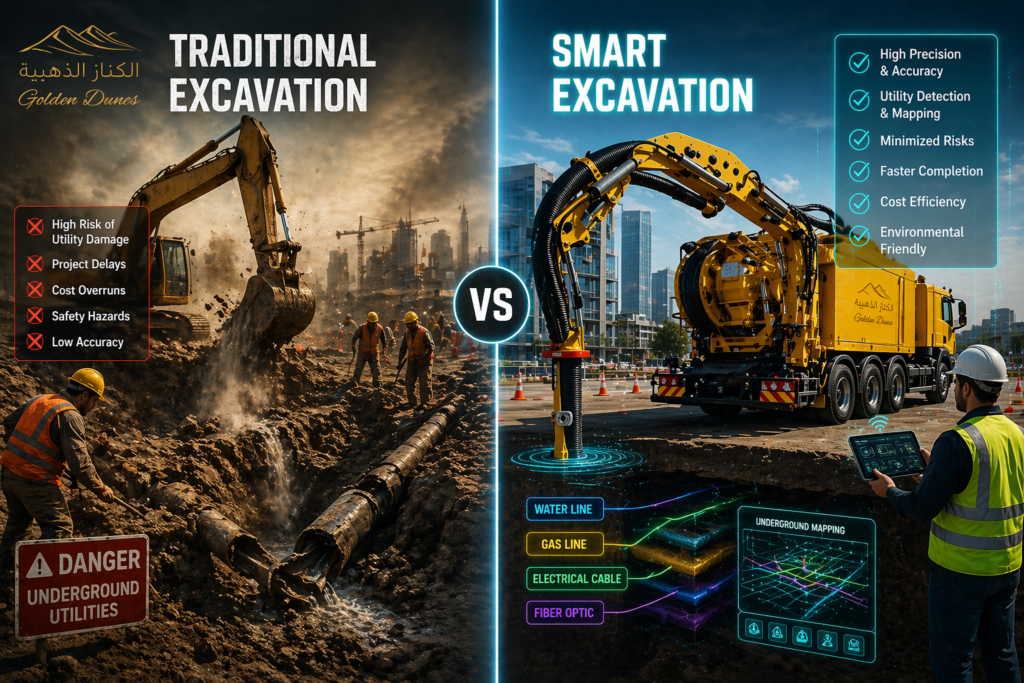
For decades, traditional excavation has been the default approach across many construction sites. While it remains widely used, its limitations have become increasingly visible in complex environments. In contrast, modern projects now demand a more controlled and data-driven approach, where Excavation Planning plays a central role in reducing uncertainty and improving execution quality.
The difference between traditional and smart excavation is not only about equipment—it is about methodology. Traditional approaches often rely on assumptions, manual processes, and limited site data. On the other hand, modern excavation integrates technology, precise analysis, and structured planning to ensure safer and more efficient outcomes.
Limitations of Traditional Excavation Methods
In many cases, traditional mechanical excavation operates without full visibility of subsurface conditions. This increases the likelihood of excavation hazards, especially in areas with dense underground utilities. Without accurate mapping or verification, excavation work becomes reactive, leading to interruptions and project delays.
Additionally, relying on outdated excavation practices often exposes projects to risks associated with imprecise digging, equipment overuse, and damage to surrounding infrastructure. These issues are particularly critical in modern construction projects, where precision is no longer optional.
The Rise of Smart Excavation Technologies
Modern excavation is defined by the integration of advanced tools and technologies that improve control and accuracy. Solutions such as non-destructive excavation methods allow teams to perform precise excavation while minimizing physical impact on buried infrastructure.
These methods support safer excavation by reducing direct contact with critical assets and limiting the potential for damage during excavation. As a result, they play a key role in helping teams reduce excavation risks and maintain consistent progress throughout the project lifecycle.
Controlled Excavation and Data-Driven Execution
A defining feature of modern approaches is controlled excavation. This concept focuses on executing excavation work within clearly defined parameters, supported by accurate data and continuous monitoring. By combining detailed Excavation Planning with real-time insights, teams can anticipate challenges and adjust operations proactively.
This level of control also improves coordination between different project stakeholders, ensuring that excavation activities align with broader construction timelines. It transforms excavation from a high-risk phase into a managed and predictable process.
Efficiency, Safety, and Long-Term Value
Beyond risk reduction, smart excavation approaches deliver measurable improvements in efficiency and cost management. By reducing errors, minimizing rework, and protecting existing infrastructure, projects can achieve more efficient excavation and avoid unnecessary expenditure.
At the same time, integrating advanced safety frameworks such as smart site safety systems ensures that safety protocols are consistently enforced. This helps improve safety across all excavation activities while protecting both workers and assets.
Ultimately, the transition from traditional to smart excavation reflects a broader industry shift. Companies that invest in modern techniques and strong Excavation Planning gain a clear advantage—delivering projects faster, safer, and with greater operational control.
The Golden Dunes Approach to Smarter Excavation

In high-risk environments, effective Excavation Planning is not just about preparation—it is about execution backed by technology, precision, and real-time control. This is where Golden Dunes positions its methodology: transforming excavation from a reactive task into a structured, data-driven operation that prioritizes safety, efficiency, and continuity.
Rather than relying on assumptions or traditional excavation alone, Golden Dunes integrates advanced engineering practices across its construction and infrastructure solutions, ensuring that every excavation project is approached with a clear understanding of site conditions, risks, and performance expectations.
Non-Destructive Excavation for Precision and Safety
A key element of this approach is the adoption of non-destructive excavation methods, particularly advanced suction excavation. This technique allows teams to expose underground utilities without direct mechanical impact, significantly reducing the risk of damage during excavation.
By enabling precise excavation, this method improves excavation safety while minimizing disruption to surrounding infrastructure. It is especially effective in areas with high utility density, where traditional digging methods often increase the likelihood of costly incidents.
Advanced Inspection and Subsurface Intelligence
Accurate data is a cornerstone of strong Excavation Planning. Golden Dunes enhances this through technologies such as MTM pipeline inspection, which allows for non-intrusive evaluation of subsurface conditions.
These inspection capabilities ensure that risks are identified before excavation begins, reducing uncertainty and improving decision-making. By combining inspection data with structured planning, projects gain a higher level of control over execution and risk exposure.
Integrated Safety Systems and Real-Time Monitoring
Safety is not treated as a secondary layer—it is embedded into the excavation process itself. Through solutions like smart safety systems, Golden Dunes enables continuous monitoring of excavation activities, ensuring that safety protocols are consistently maintained.
This approach helps reduce risks to workers and ensures compliance with industry standards. More importantly, it allows teams to respond proactively to potential issues, preventing minor concerns from escalating into major disruptions.
From Risk Exposure to Controlled Execution
The real value of this approach lies in shifting excavation from uncertainty to predictability. By combining Excavation Planning with modern technologies and structured workflows, Golden Dunes supports controlled excavation that aligns with project timelines and performance goals.
Instead of reacting to problems after they occur, this model focuses on preventing them altogether. It ensures that excavation activities remain efficient, compliant, and aligned with broader project objectives—helping organizations maintain continuity and avoid the cascading effects of poor planning.
Ultimately, the Golden Dunes approach reflects a simple principle: successful excavation is not defined by speed alone, but by the ability to reduce risks, protect infrastructure, and deliver consistent results in even the most demanding project environments.
Best Practices for Effective Excavation Planning

Strong Excavation Planning is not a single step—it is a structured process that integrates analysis, coordination, and execution. In modern construction projects, applying proven best practices is essential to reduce excavation risks, maintain safety standards, and ensure that excavation work progresses without disruption.
Organizations that consistently deliver successful outcomes follow a disciplined approach that begins before excavation begins and continues throughout the entire excavation phase. These practices are designed to minimize uncertainty, improve decision-making, and support efficient excavation across all types of projects.
Comprehensive Site Analysis and Soil Assessment
A detailed understanding of site conditions is the foundation of any successful excavation project. Conducting a thorough soil assessment helps identify poor soil zones, drainage issues, and potential instability risks that could impact excavation work.
Without this step, teams may face unexpected ground behavior that leads to project delays and additional costs. Early analysis ensures that excavation methods are aligned with site conditions, reducing uncertainty and improving overall performance.
Accurate Utility Detection and Verification
One of the most critical elements of Excavation Planning is verifying the presence and location of underground utilities. Inaccurate data or assumptions can result in serious damage during excavation, exposing projects to operational and financial risks.
Using modern detection and validation techniques helps teams reduce the risk of utility strikes and maintain safe working conditions. This step is particularly important in high-density environments where multiple utility networks overlap.
Selecting the Right Excavation Method
Choosing the appropriate excavation method is essential for achieving both safety and efficiency. While traditional excavation may be suitable in some conditions, more complex environments require advanced solutions that support safer excavation.
For example, leveraging insights from vacuum excavation vs traditional excavation comparisons can help decision-makers select the most effective approach for their project. The right method ensures better control, reduces errors, and improves overall excavation performance.
Implementing Structured Risk Assessment
A proactive risk assessment framework allows teams to identify potential excavation hazards before they impact the project. This includes evaluating environmental conditions, equipment requirements, and operational constraints.
By applying structured excavation risk management, organizations can reduce risks early and prevent minor issues from escalating into major disruptions. This approach also improves coordination between teams and supports more predictable execution.
Continuous Monitoring and Adaptive Execution
Effective Excavation Planning does not end once work begins. Continuous monitoring of excavation sites ensures that any changes in conditions are identified and addressed in real time. This helps maintain control over excavation activities and prevents unexpected failures.
By combining planning with ongoing oversight, teams can adapt quickly, maintain safety standards, and keep projects on schedule. This level of responsiveness is essential in modern infrastructure projects, where conditions can change rapidly.
Ultimately, these best practices highlight a key principle: successful excavation is not about reacting to problems—it is about preventing them through strong Excavation Planning. Organizations that adopt this mindset gain a clear advantage in delivering projects that are safer, more efficient, and more predictable.
Frequently Asked Questions About Excavation Planning